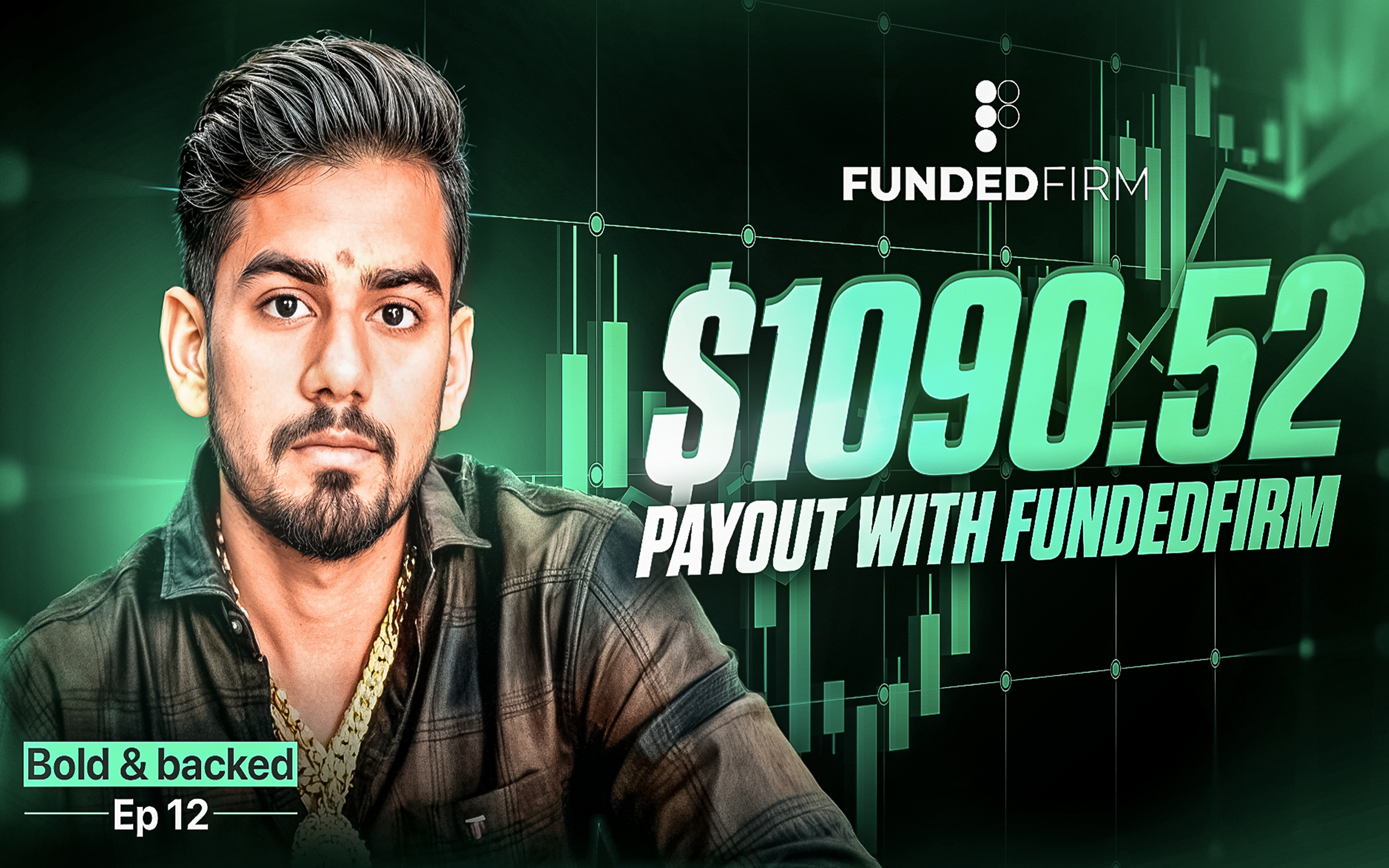
For many traders, the road to consistency begins with a simple desire for financial independence. For Karan, a trader from Rajkot, Gujarat, that desire became the starting point of a transformative journey. His story reflects the struggles, breakthroughs, and mindset shifts that many aspiring traders experience but rarely articulate. Today, after two to two and a half years of trading, he stands as an example of what discipline, risk management, and the right trading environment can achieve.
Karan belongs to the city of Rajkot in Gujarat. He has been actively trading for the last two to two and a half years. He started in the Indian market and later transitioned to the forex market. Today he trades under a funded firm model and has successfully completed a two phase challenge with remarkable speed.
He comes across as calm, self aware, honest about mistakes, and deeply disciplined about risk. His journey is relatable for aspiring traders who are finding their footing in the world of price action and funded accounts.
Karan’s trading journey did not begin with passion or fascination for charts. Before he entered the markets, he was preparing for a government job. Trading was something he picked up purely for money. There was no dramatic story or sudden spark. Just a simple motivation: he wanted to earn.
In his early days, he traded in the Indian market and gradually shifted to the forex market. Over time, he realized that trading demanded not only technical skills but emotional composure, risk discipline, and an understanding of market behavior. As he explored different prop firms, he tested four to five platforms before finding the one that aligned with his trading style.
The turning point came when he discovered a funded firm that gave him what he valued the most: freedom. Freedom to choose his lot size, freedom to manage his own risk, and freedom to apply the logic and psychology that shaped his personal trading system.
Like every trader, Karan faced psychological and technical challenges.
He openly admits that his most toxic trades were the ones where he took big losses. These losses would weigh on him emotionally, which is why he built his entire system around risk reward ratios. He worked with 1:5, 1:6, and even 1:7 risk reward setups.
His philosophy became simple. If the loss is small and controlled, the strong risk reward structure will eventually take care of long term profitability.
Another challenge was execution. He learned that no matter how good the analysis is, a poorly executed entry ruins everything. This awareness pushed him to focus on entering trades with precision and clarity.
Once Karan discovered a FundedFirm whose rules were minimal and trader friendly, his performance improved dramatically.
Here are the fund specific features that helped him grow:
Karan repeatedly emphasizes that the biggest attraction was the lot size flexibility. For him, risk management is the strongest weapon a trader has. Being allowed to choose any risk level on a particular trade empowered him to structure his positions exactly the way his strategy required.
According to Karan, other prop firms restrict traders in ways that affect their risk control. In contrast, this platform allowed him the freedom to take 3 percent, 4 percent, or even 5 percent risk per trade when he deemed it appropriate. He could do this only because it was a funded account and not his own money. If it were his own capital, he would never take 5 percent risk.
He had experience with four to five other firms. Compared to all of them, this one had fewer rules. It offered the level of independence that he believes every trader needs for growth.
He managed his drawdowns by respecting the maximum limit set for his account. For instance, with a 15000 dollar account that had a 10 percent maximum drawdown, he focused only on that 10 percent. For a 5000 dollar account, his 500 dollar drawdown limit guided his risk per trade. By dividing this into 3 percent or 4 percent risk blocks, he avoided emotional decisions and maintained technical clarity.
Karan’s entire trading philosophy can be summed up in one line:
“If I control my loss, then my risk reward itself is such that it can keep me profitable even in the long term.”
This belief reflects his maturity, discipline, and commitment to controlled risk taking.
Karan trades price action breakouts using support, resistance, and trend line structures. Over time, he added his own psychological insights and logic to refine his entries.
He shared a simple example from his approach. If the market is trading on a support level that has already been tested three or four times, he anticipates that the support has a higher chance of breaking. Before the breakout actually happens, he initiates his trade. Once the real breakout takes place, strong buying or selling generally follows, allowing him to capture high risk reward setups.
He applies this concept consistently, especially in gold, which is the only instrument he trades. He participates in the Tokyo, London, and New York sessions. All three sessions provide him opportunities to apply his system and maintain liquidity.
One of the most revealing parts of his interview came when he was asked what he focuses on the most during trade entries.
His answer was simple and powerful: execution.
He believes that the more perfectly he executes, the lower the chances of making mistakes. Once he has placed the trade with precision, the market will do its job. If his analysis is correct, the results will follow. If he is wrong, the market will reward him according to the mistake. His role is to enter with discipline and clarity every single time.
Karan completed his two phase challenge of the funded firm in just 10 to 11 days. This is a strong reflection of his risk reward structure, his conviction in price action, and his ability to maintain emotional stability even during drawdowns.
Although he does not mention specific P&L numbers, his rapid challenge completion and controlled risk approach show that he has made significant progress from his early uncertainty. He has transformed from a government job aspirant into a focused trader who operates with logic, discipline, and awareness.
Karan’s journey reminds us that trading success is not about shortcuts or magical indicators. It is built on steady refinement, patience, and respecting drawdown limits. His approach highlights the importance of freedom, structure, and psychological clarity.
As he continues to grow, his philosophy will inspire countless traders who are still struggling with risk management and emotional discipline.
Thank you, Karan. Your journey inspires us, and we cannot wait to see more growth in the coming year.
Get funded today and start achieving your financial goals.

Be the first to know about promotions and discount
Ensure you manage your risk by never exceeding the set drawdown limits. Protect your capital and trade with discipline to preserve long-term profitability.
Achieve consistent profitability by adhering to your trading plan. Fundedfirms typically require a minimum monthly profit target to maintain funding and access to capital.
Follow the firm's guidelines regarding trading strategies, including asset types and trade volume. Staying compliant ensures you remain within the terms of the agreement and avoid penalties.



Trading involves risk and may not be suitable for all individuals. FundedFirm offers skill-based evaluations using simulated trading accounts only. Past performance does not guarantee future results. Funding and payouts are subject to program rules and compliance.
FundedFirm LTD. does not provide services for citizens/residents of the USA, Cuba, Iraq, Myanmar, North Korea, Sudan, Iran, Russia. The services of FundedFirm LTD. are not intended for distribution to, or use by, any person in any country or jurisdiction where such distribution or use would be contrary to local law or regulation.